
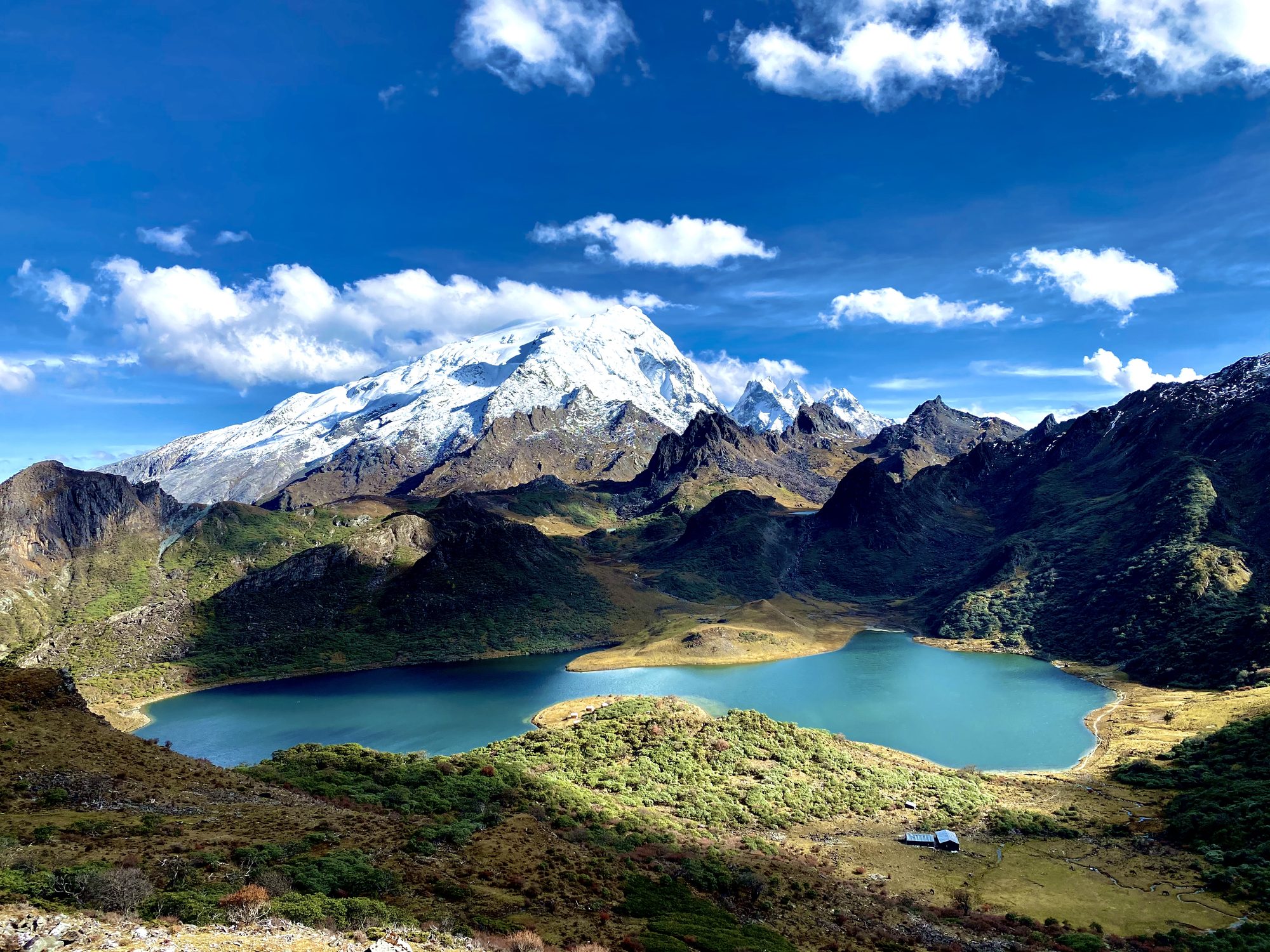
In the footsteps of the Yellow Hats (Gelugpa), a 13-day journey into the heart of Amdo: the great monasteries of Labrang in Xiahe, Repkong in Tongren and Khumbum, five days of trekking on foot between Xiahe and Tongren with a pass at 3,900m, and the ascent of Mount Babaoshan, the sacred mountain of the Yellow Hats.
Trip Highlights
The great Gelugpa monasteries
The great Gelugpa monasteries of Labrang, Khumbum and Repkong, visited along the way.
Mount Babaoshan
The ascent of Mount Babaoshan, the sacred mountain of the Yellow Hats, which Tsongkhapa himself climbed many times.
The plateau and the Tibetan people
The wide open spaces of the plateau and encounters with the Tibetan people, from plains of nomads to valleys of yaks and sheep.
Shachong Monastery
Shachong Monastery, perched on a mountaintop and close to the birthplace of the Dalai Lama.
Route Overview
Lanzhou
Welcome and transfer to your hotel.Lanzhou → Bingling Caves → Xiahe
The Bingling caves by boat, then the Tibetan town of Xiahe (2,900m).The Ganjia plain
Acclimatisation day: a small peak, a fortified village, a Bön temple.Xiahe: Labrang Monastery
The monastery kora (4km) and a free afternoon.Trek Xiahe → Tongren
Five days between Labrang and Repkong, Chadangka pass (3,900m), about 72km.Tongren → Kanbula
Repkong Monastery, Wutong temple and thangka workshops, then the Yellow River.Shachong → Mount Babaoshan
Shachong temple, then the climb to camp at the foot of Babaoshan.Mount Babaoshan → Xining
The summit among prayer flags, then the road to Xining.Khumbum → Lanzhou
Khumbum Monastery, then the fast train to Lanzhou.Full Itinerary
Lanzhou
Welcome in Lanzhou and transfer to your hotel.
Lanzhou → Bingling → Xiahe
This morning you visit the Bingling caves, a magnificent group of Buddhist statues tucked into the depths of a gorge and reached by boat. At the end of the day you arrive in the Tibetan town of Xiahe, where you will spend three nights. The altitude is already clearly felt.
Xiahe: the Ganjia plain
Acclimatisation day on the Ganjia plain. After about 30 minutes by road, you begin the day with the short climb of a small peak, perfect for acclimatisation and a superb viewpoint over the fortified village of Bajiaocheng. You then walk to a Bön temple (the indigenous Tibetan religion, which predates Buddhism) and pass a sky burial site. You return to Xiahe during the afternoon.
Xiahe: Labrang Monastery
This morning you visit the great Labrang Monastery, starting with its kora. This pilgrimage path around the monastery's walls is 4km long and you will take the morning to complete it. The fervour of pilgrims from all over Tibet plunges you straight into this fascinating culture and religion. Free afternoon: you can visit Labrang's many temples.
Trek Xiahe → Tongren
You set off this morning on five days of trekking between the monasteries of Labrang (in Xiahe) and Repkong (in Tongren). You begin by climbing a pass at 3,500m before descending into a gigantic plain inhabited by nomads, where you spend your first night in tents.
The second stage alternates between small passes and wide open spaces, then ends at the foot of steeper mountains in a place known as “the valley of love”, where many nomad families live in summer with their herds. You then cross the highest point of the trek, the Chadangka pass (3,900m), descend into a valley full of yaks and sheep and gradually enter more arid territory. The last part is a long descent to the Repkong valley, at 2,500m.
Tongren → Kanbula
You visit the great Repkong Monastery in the morning. You then go to Wutong temple, 5km from town: around this temple are the most important thangka workshops and institutes, the major pictorial art of Tibet. An hour's drive then takes you to the banks of the Yellow River, where you spend the night.
Shachong → Mount Babaoshan
This morning you visit the magnificent and very important Shachong temple, on the summit of Amnye Shachong mountain and close to the birthplace of the current Dalai Lama. Founded more than four centuries ago, it is where the master Tsongkhapa studied, founder of the Yellow Hat school. You then go to the foot of Mount Babaoshan, the sacred mountain of the Yellow Hats, which Tsongkhapa himself climbed many times; a statue of the master stands at its foot. The climb to camp is short but steep: after 1.5 hours of walking, you reach a flat spot where the tents can be pitched, with a water point 5 minutes away. The view plunging down to the Yellow River valley is simply splendid.
Mount Babaoshan → Xining
After packing up camp, you continue the climb. It is still fairly steep through grassy slopes before the surroundings become more mineral. You climb a small rocky gully and reach a flat spot near the summit. The altitude is felt here, but the many prayer flags give the atmosphere a special quality and help you in your effort. You reach the summit after a final hour of walking among the flags. The view is fantastic: you stand directly above the village where the current Dalai Lama was born, and the fervour of the Tibetans gathered here reminds you that this place is sacred. The descent is fairly long; you return to the vehicle after about 3 hours of walking, then drive to Xining, capital of Qinghai province and the largest city on the Tibetan plateau.
Khumbum → Lanzhou
The last day of this journey through the land of the Yellow Hats, and you finish in style with a visit to Khumbum temple, one of the six great Gelugpa monasteries of the region. It stands on the exact birthplace of Tsongkhapa, and it is also in this monastery that the famous explorer Alexandra David-Néel lived for three years to prepare for her journey to Lhasa. Fast train to Lanzhou in the afternoon. End of our services.
What's Included
Booking Terms
- Cancellation terms depend on how close to departure you cancel, and are confirmed in writing when your trip is booked.
- If a visa application is refused, we ask for the official refusal letter from the consulate and refund what we can once any costs already committed on your behalf are deducted.
- A confirmed place can usually be transferred to another eligible traveller.
- If safety conditions or government restrictions force a change, we'll adapt or refund the unused portion of the trip.
Get in Touch
We don't take bookings online — this site is here to show you the treks. Reach out and let's talk through dates, group size and what you're looking for.